

TL;DR:
I tested four popular AI detectors, Humalingo, GPTZero, ZeroGPT and Winston AI, using both AI-written and human-written paragraphs. Most correctly identified both, but Humalingo stood out by also showing possible copied sources. GPTZero is the easiest option for students, while ZeroGPT is useful for bloggers who want quick sentence-level checks. Still, no AI detector is 100% accurate, so use the results as a guide, not a final verdict.
What Is an AI Detector?
AI detectors are tools that help identify whether content was written by a person or generated by AI tools like ChatGPT, Gemini or Claude. They analyze writing patterns and language usage to estimate how likely the content is to be AI-generated.
Quick Guide to Detect AI-Generated Content
With AI writing becoming harder to spot, AI detectors can help check whether content is likely written by a human or AI. I tested multiple tools in real-world scenarios and picked the 4 that gave me the most reliable results.
But accuracy wasn’t the only thing I looked at. I also checked extra features like sentence-level analysis, plagiarism detection, source tracking and overall ease of use.
How to test these ai detector tools
To keep the test fair, I did two simple tests. First, I used a 170-character text generated by ChatGPT to see if the tools correctly detect it as AI content. Then I tested a human-written paragraph to check if the tools identify it as human content. Based on these results, I listed the AI detectors that performed the best.
AI vs Human Writing Test
Switch between the two samples used to test AI detectors.
ChatGPT Generated Text
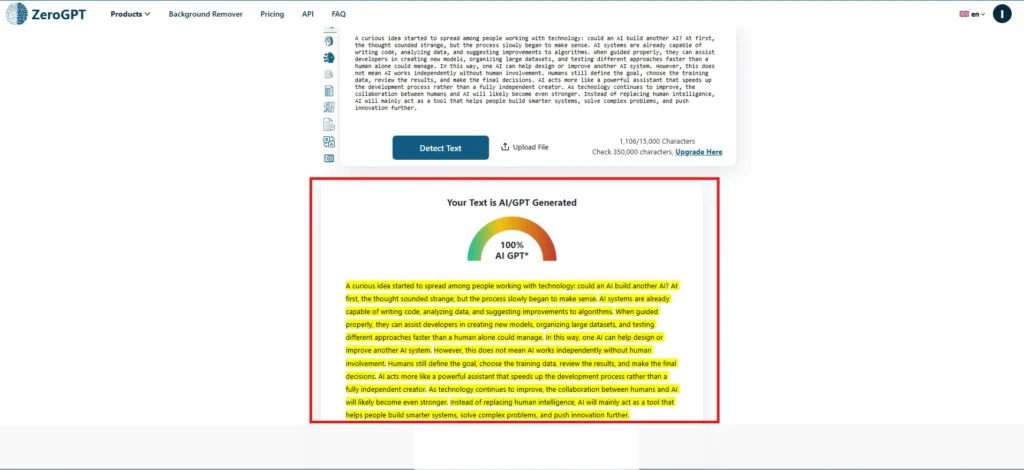
A curious idea started to spread among people working with technology: could an AI build another AI? At first, the thought sounded strange, but the process slowly began to make sense. AI systems are already capable of writing code, analyzing data, and suggesting improvements to algorithms. When guided properly, they can assist developers in creating new models, organizing large datasets, and testing different approaches faster than a human alone could manage.
In this way, one AI can help design or improve another AI system. However, this does not mean AI works independently without human involvement. Humans still define the goal, choose the training data, review the results, and make the final decisions. AI acts more like a powerful assistant that speeds up the development process rather than a fully independent creator. As technology continues to improve, the collaboration between humans and AI will likely become even stronger. Instead of replacing human intelligence, AI will mainly act as a tool that helps people build smarter systems, solve complex problems, and push innovation further.
Human Generated Text
In all these situations you must pay attention, and you will perform less well, or not at all, if you are not ready or if your attention is directed inappropriately. System 2 has some ability to change the way System 1 works, by programming the normally automatic functions of attention and memory.
When waiting for a relative at a busy train station, for example, you can set yourself at will to look for a white-haired woman or a bearded man, and thereby increase the likelihood of detecting your relative from a distance. You can set your memory to search for capital cities that start with N or for French existentialist novels. And when you rent a car at London’s Heathrow Airport, the attendant will probably remind you that “we drive on the left side of the road over here.” In all these cases, you are asked to do something that does not come naturally, and you will find that the consistent maintenance of a set requires continuous exertion of at least some effort.
Now let’s see which tool actually performed the best in this test.
Quick Comparison of AI Detectors (2026)
Feature |  Humalingo
 |  GPTZero
 |  ZeroGPT
 |  Winston AI
 |
|---|---|---|---|---|
| Try Now | Try Humalingo | Try GPTZero | Try ZeroGPT | Try Winston |
| AI Detection Accuracy (Test) | 100% AI detected | 100% AI detected | 100% AI detected | 99% AI detected |
| Human Text Detection | 100% Human | 100% Human | 100% Human | 98% Human |
| Detection Method | AI pattern analysis | Writing pattern analysis | AI probability scoring | Advanced AI analysis |
| Sentence-Level Analysis | No | No | Yes | Yes |
| AI Image Detection | No | No | No | Yes |
| Plagiarism Checker | Yes | Yes | Yes | Yes |
| Free Usage | Paid Tool | 10,000 words/month | 15,000 characters/check | 2000 credits |
| Best For | Content creators & SEO professionals | Students & educators | Bloggers & content writers | Universities & organizations |
| Ease of Use | Very simple | Very simple | Very simple | Slightly advanced |
| Enterprise Features | Moderate | Limited | Moderate | Strong |
AI Detector Pricing Comparison (2026)
Pricing can play a major role when choosing an AI detector, especially if you plan to use it regularly. To help you compare the available options, I’ve summarized the most popular plans, pricing, and target users for each tool below. This should give you a quick idea of which AI detector offers the best value for your needs.
| Tool | Free Plan | Most Popular Plan | Starting Price (Monthly) | Monthly Limit | Best For |
|---|---|---|---|---|---|
|
Humalingo | No | Annual Plan | $9.99/month | Unlimited working history | Content creators & SEO professionals |
|
GPTZero | Yes | Premium | $23.99/month | 300,000 words/month | Students & educators |
|
ZeroGPT | Yes | Plus | $14.99/month | 100,000 AI detections/month | Bloggers & content writers |
|
Winston AI | Yes (14-Day Trial) | Essential | $10/month | 80,000 credits/month | Publishers & organizations |
Pros and Cons of the Top AI Detectors
Humalingo- Very accurate, got both tests 100% right
- Shows plagiarism sources + matching text
- Combines AI detection + plagiarism in one tool
- Fast and simple to use
- No free plan, paid only
- Turbo Scan mode is less accurate than Teacher Mode
- Accuracy can drop on heavily rewritten content
GPTZero- Generous free plan (10,000 words/month)
- Very easy, clean interface
- Trusted by schools & universities
- Good for quick checks
- Struggles with heavily edited AI content
- Fewer advanced features than rivals
- Limited enterprise tools
ZeroGPT- Sentence-level analysis shows exact AI parts
- Free tier available (15,000 characters/check)
- Great for bloggers needing fast checks
- Supports multiple AI models
- Occasionally flags human text as AI
- Not always 100% accurate
- Free usage has limits
Winston AI- Very accurate, low false-positive rate
- Can detect AI-generated images too
- Clean, professional interface
- Great for orgs needing serious verification
- Free trial is limited (14 days)
- Advanced features need higher-paid plans
- Less mainstream / smaller user base
1. Humalingo
Humalingo is a dedicated AI detection tool that can analyze content and identify whether it appears AI-generated or human-written. It also includes an AI humanizer feature.
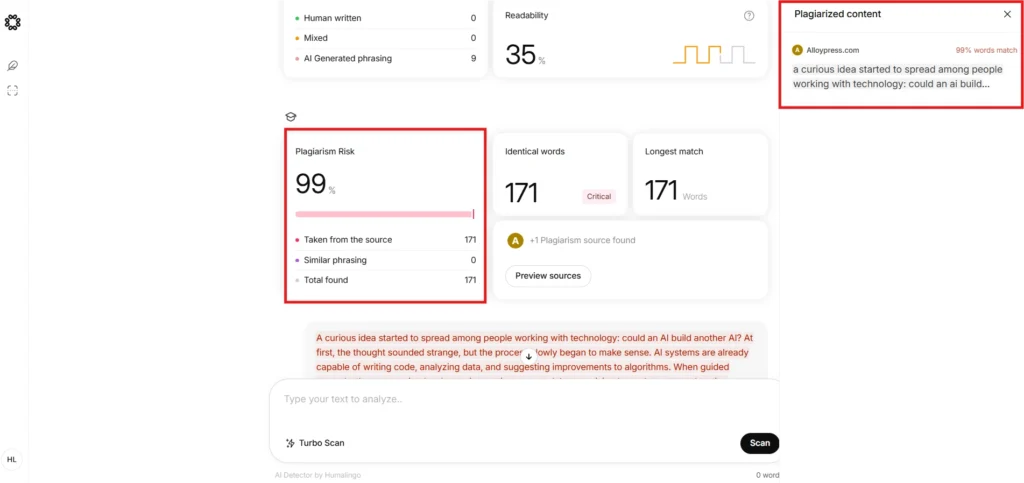
The reason I placed this tool first is that it successfully passed both Test 1 and Test 2. Another feature I found useful is that it not only shows the plagiarism risk score but also helps identify where similar content appears online. It even highlights the matching lines and the exact pages where they were found, which I found very interesting.
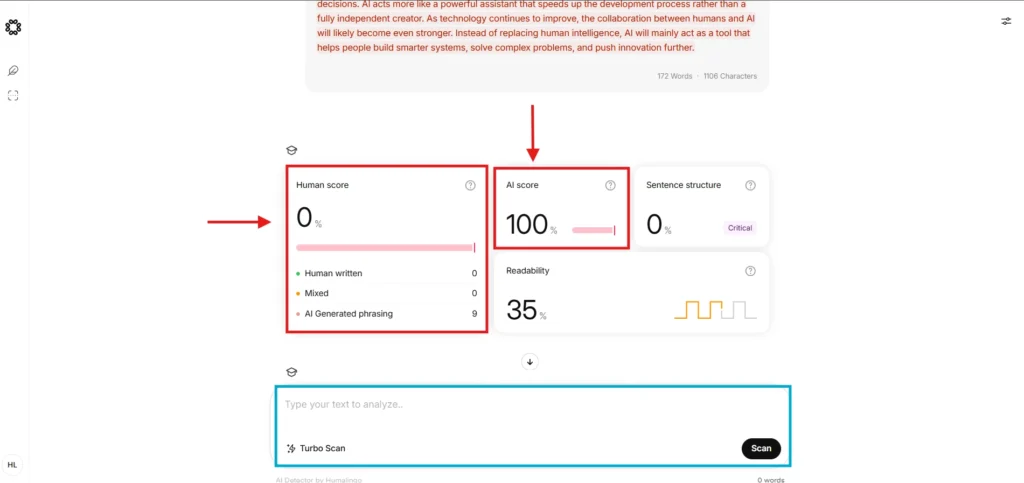
To use it, select the Detect AI Content option and switch the scan mode from the default Turbo Scan to Teacher Mode, as this currently provides the best results. Then paste your content and start the scan. Within a few seconds, you’ll see the results. I’ve shared my results below.
One thing that stood out to me while using Humalingo was the plagiarism reporting feature. Most AI detectors simply tell you whether content appears AI-generated, but Humalingo goes a step further by showing matching sources and highlighted text. For anyone reviewing content regularly, this extra layer of information can save a lot of time.
Test -1 (ChatGPT Generated Content)
Humalingo AI detected the ChatGPT content as 100% AI-written. Screenshot attached below for reference.
Test -2 (Human Written Content taken from book)
When I pasted a human-written paragraph into the tool, the result showed 100% human-written content.
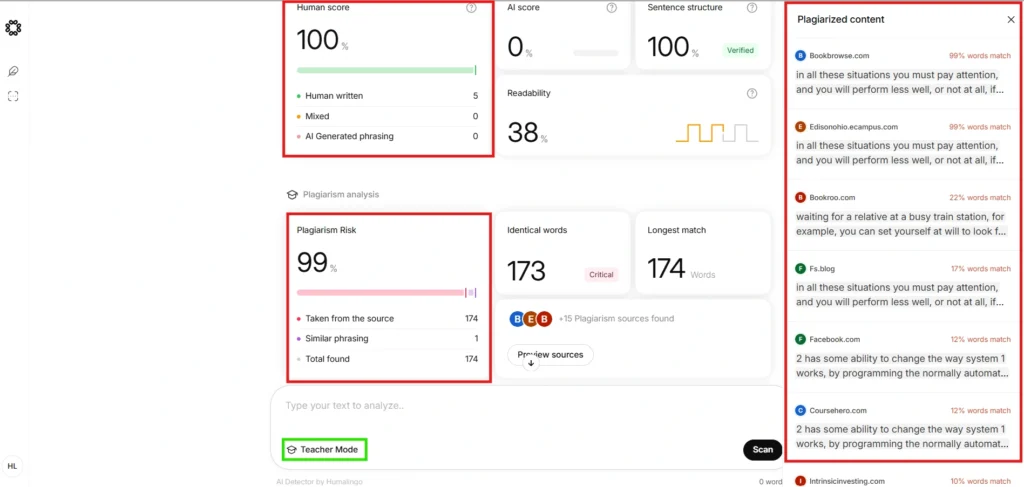
I also really like that it not only shows the plagiarism risk score, but also tells me which websites contain similar content and the percentage of matching text. It’s a very useful feature.
2. GPTZero
GPTZero is one of the earliest AI detection tools and is widely used in education. It analyzes writing patterns to identify AI-generated text.
They give free users 10,000 words per month and you can also try 3 advanced scans.
Test -1 (ChatGPT Generated Content)
GPTZero AI detected the ChatGPT content as 100% AI-written. Screenshot attached below for reference.

Test -2 (Human Written Content taken from book)
When I pasted a human-written paragraph into the tool, the result showed 100% human-written content.
GPTZero felt like the most straightforward tool in this comparison. The interface is clean, the results are easy to understand, and it doesn’t overwhelm users with extra options. I can see why it remains popular among students and educators.

3. ZeroGPT
ZeroGPT is an AI detector that checks whether a piece of text is written by a human or generated by AI. You can paste text into the tool and it shows the percentage of AI vs human-written content. It is commonly used by students, educators and content teams to check content authenticity.
Free users can check up to 15,000 characters per AI detection.
Test -1 (ChatGPT Generated Content)
ZeroGPT AI detected the ChatGPT content as 100% AI-written. Screenshot attached below for reference.
Test -2 (Human Written Content taken from book)
I took a paragraph from a book written by a human and pasted it into the tool. It showed 100% human-written content.
What I liked most about ZeroGPT was its sentence-level analysis. Instead of only showing an overall score, it highlights specific sections that may have been generated by AI. This can be particularly useful when reviewing long-form content.

4. Winston AI
Winston AI is a tool used to check whether a piece of text was written by a human or generated by AI. It analyzes the content and highlights parts that may be AI-generated. Many educators, publishers and content teams use it to check originality and keep their content trustworthy.
New users get 2000 free credits at the start. For example, if you paste a 200-words paragraph, it will use 200 credits to analyze it. The tool can also detect AI-generated images and each image check uses 300 credits.
Test -1 (ChatGPT Generated Content)
Winston AI detected the ChatGPT content as 99% AI-written. Screenshot attached below for reference.

Test -2 (Human Written Content taken from book)
I took a paragraph from a book written by a human and pasted it into the tool. It showed 98% human-written content.
Winston AI felt more focused on professional and organizational use cases. Features such as AI image detection and detailed analysis make it more suitable for users who need advanced verification rather than occasional content checks.

Can AI Detectors Be Wrong?
Yes. No AI detector is 100% accurate. During my testing, I found that human-written content can sometimes be flagged as AI, while edited AI content may pass as human.
For this reason, AI detection scores should be used as a reference rather than a final verdict.
What I Learned After Testing These AI Detectors
After testing all four tools, one thing became clear: no AI detector should be treated as a final authority. While all of them performed well on the sample tests, their real-world accuracy can vary depending on how the content was written, edited, or rewritten. Instead of focusing solely on the AI score, I found it more useful to look at supporting information such as sentence analysis, plagiarism reports and source tracking before making a decision.
Final Conclusion
If you’re looking for the best overall AI detector, Humalingo is our top recommendation. It accurately detected both AI-generated and human-written content in testing while also providing detailed plagiarism reports and source tracking, making it a great all-in-one solution for content creators and SEO professionals.
GPTZero is the better choice for students and educators, ZeroGPT works well for bloggers who need quick AI checks and sentence-level analysis, and Winston AI is ideal for organizations that require advanced detection features, including AI image detection.
No AI detector is perfect, so results should be used as a guide rather than a final verdict. However, based on our testing and overall feature set, Humalingo offers the best balance of accuracy, plagiarism detection and usability for most users.
Better Decision-Making Table
| Tool | Entry Price | Free Version | Plagiarism Checker | AI Image Detection | Value for Money |
|---|---|---|---|---|---|
|
Humalingo | $9.99/mo | ❌ | ✅ | ❌ | ⭐⭐⭐⭐⭐ |
|
GPTZero | $23.99/mo | ✅ | ✅ | ❌ | ⭐⭐⭐⭐ |
|
ZeroGPT | $14.99/mo | ✅ | ✅ | ❌ | ⭐⭐⭐⭐ |
|
Winston AI | $10/mo | ✅ Trial | ✅ | ✅ | ⭐⭐⭐⭐⭐ |
0 Comments