On April 16, 2026, Anthropic announced the launch of Claude Opus 4.7. This is their newest and most powerful Opus model yet. It is now available to everyone on claude.ai, through the API and on major cloud platforms like Amazon Bedrock, Google Vertex AI and Microsoft Foundry. The model is a big upgrade from Claude Opus 4.6. It focuses on three main areas: handling tough, long-running tasks with more confidence, seeing images much better and giving more creative and professional results.
What Does the Announcement Say?
Anthropic says Claude Opus 4.7 lets users “hand off your hardest work with less supervision.” The model now thinks more carefully, follows instructions more exactly, and checks its own answers before giving them back. It is especially strong in advanced coding, complex problem-solving and creative professional jobs like designing interfaces, making slides or writing documents. The company also improved safety features, especially for cybersecurity, so the model refuses dangerous requests more reliably. They tested it heavily and shared detailed benchmarks to prove it is better than the previous version.
New Features in Claude Opus 4.7
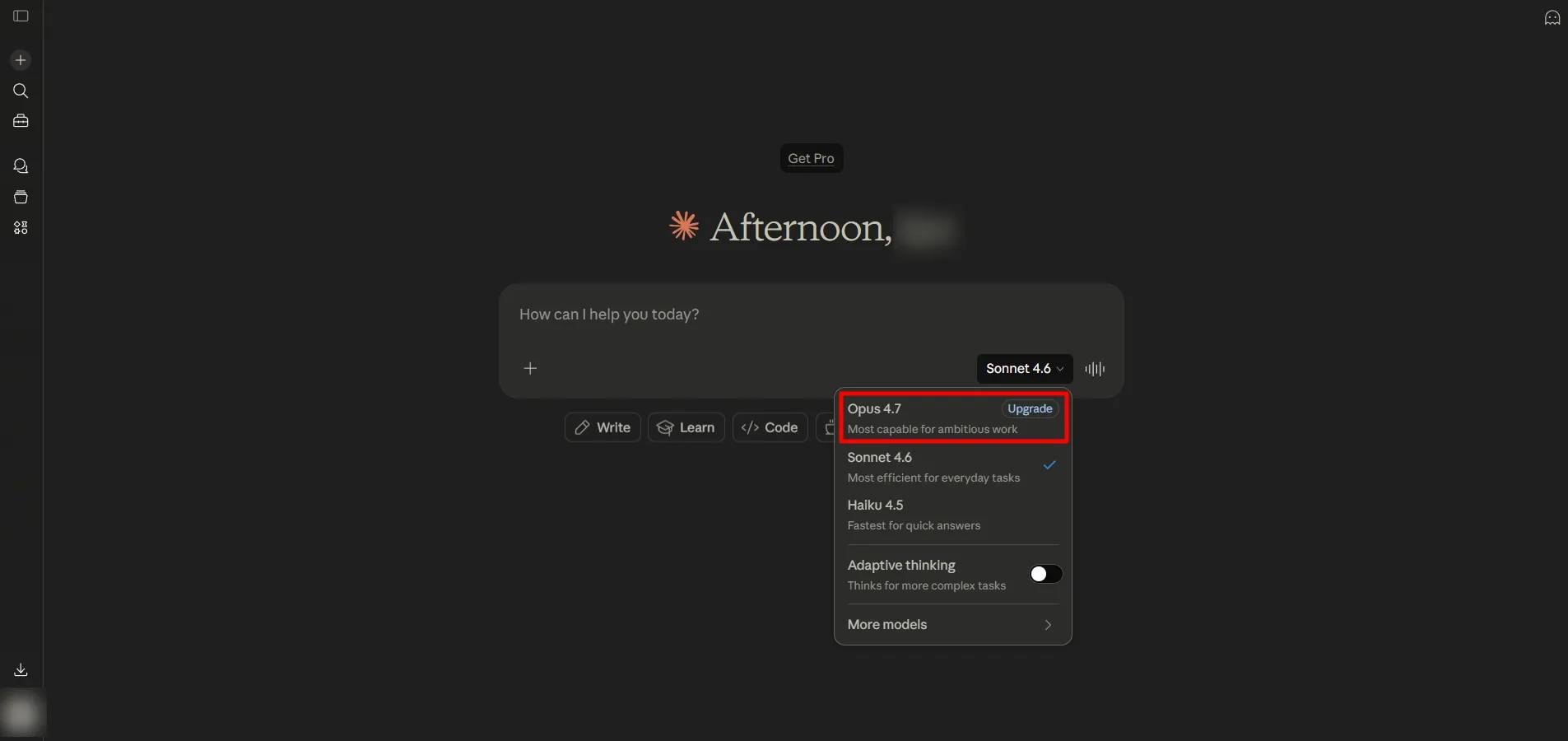
Here are the biggest new updates explained clearly.
The model now has stronger software engineering skills, with around a 13 percent improvement in solving complex coding tasks based on benchmark tests. It can catch its own mistakes during planning and complete tasks faster and it performs much better in long, multi step projects like building full applications from scratch.
It also has much better vision capabilities. It can process images up to 2,576 pixels on the longer side, which is more than three times higher resolution than before. This allows it to read small text in screenshots, understand complex diagrams and generate more detailed designs.
There is a new effort level called xhigh available in the API, which sits between high and max. This gives you better control over how much processing power is used, helping you balance speed and output quality based on your needs.
The model also comes with improved memory for handling long tasks. It can remember notes across different sessions using file system memory, so you do not need to repeat instructions every time.
New tools have been added in Claude Code as well. You can use the ultrareview command to get a detailed code review that identifies bugs and design issues like a human reviewer. Auto mode is now available for Max plan users, allowing the AI to continue working with fewer interruptions. Task budgets are also available in beta, which help control costs during long running projects.
Finally, the tokenizer has been updated. Some prompts may use slightly more tokens, around 1.0 to 1.35 times more, but overall efficiency is still maintained for practical use.
Pricing stays exactly the same as Opus 4.6: $5 per million input tokens and $25 per million output tokens.
How to Use the New Features (Simple Steps)
For coding, you can go to claude.ai or use the API and select Claude Opus 4.7. For complex tasks, choose the xhigh effort option, and you can use the ultrareview command in Claude Code to automatically check your code. For image tasks, you can upload high resolution screenshots or diagrams and the model will be able to read small details that older versions often missed.
For long projects, it is better to start a new chat and ask it to remember notes across sessions. If you are using the API, you can set task budgets to control how much it spends. For creative work, you can ask it to design things like slide decks or app interfaces, as it now produces better quality outputs with improved creativity.
As a quick start tip, if you were using Opus 4.6 before, you can simply switch the model name in the API to claude opus 4.7. However, you may need to slightly adjust your old prompts since it now follows instructions more strictly.
Claude Opus 4.6 vs Opus 4.7 (Simple Comparison)
Here’s a quick comparison between Opus 4.6 and Opus 4.7 to understand what actually changed.
Feature | Opus 4.6 | Opus 4.7 |
|---|---|---|
Coding Performance | Good | Better with ~13% improvement and self-checking |
Error Handling | Basic | Catches its own mistakes more effectively |
Vision (Image Understanding) | Limited resolution | Higher resolution, reads small details clearly |
Effort Levels | High and Max | New xhigh option for better control |
Long Task Handling | Decent | Improved with memory across sessions |
Tools | Basic Claude Code tools | Adds ultrareview, auto mode, task budgets |
Speed | Slightly faster | Slightly slower on high effort tasks |
Token Usage | Normal | Slightly higher in some cases |
Pricing | $5 input / $25 output | Same pricing |
Overall Use Case | General tasks | Better for complex and long projects |
Advantages of Claude Opus 4.7
It is more reliable because it checks its own work and clearly admits when there is not enough data, which helps reduce unnecessary mistakes. It also saves time, as developers can complete complex tasks faster without constant monitoring. It is better suited for real world use because of its improved vision quality and creativity, making it useful across areas like design, finance, legal work and multi step projects. At the same time, it is safer, with stronger controls to block risky cybersecurity related requests. It is also easy to try since it comes at the same price, is widely available and offers free ultra reviews for Pro and Max users.
Disadvantages of Claude Opus 4.7
One drawback is higher token usage, as some prompts now consume more tokens, which can increase costs if you use it heavily. It can also feel slightly slower on maximum effort tasks because the extra processing takes more time. There are also user complaints, especially on X, where some people feel it performs like a reduced version of Opus 4.6 and believe the older model was made weaker to highlight 4.7. For users who only rely on simple chats, the improvements may not feel very significant. In addition, rate limits still exist, so heavy users can quickly reach daily or weekly usage limits just like before.
Other Updates from Anthropic
Alongside Opus 4.7, Anthropic has been rolling out a few more updates. The community reaction has been mixed, with some users jokingly calling it “pre-nerf 4.6.” They also introduced Claude integration for Microsoft Word, allowing users to edit documents directly without switching between tools. In addition, the Claude Code hackathon is back, offering a week of collaboration with the team and up to $100K in API credits. Overall, these updates show that Anthropic is not just improving the model but also expanding its ecosystem with better tools and stronger developer engagement.
Final Analysis and Conclusion
Claude Opus 4.7 is a solid, practical upgrade that makes AI more useful for serious work, especially coding and visual tasks. Anthropic focused on making the model more honest, careful and safe instead of just chasing raw power. The new vision, self-checking ability and extra tools like ultrareview show they listened to what developers actually need.
This release proves Anthropic is serious about responsible AI. They are testing strong safeguards on Opus 4.7 before releasing even more powerful “Mythos” models later. For regular users and businesses, this means you can now trust the AI with harder jobs and get better results with less effort.
Overall, Claude Opus 4.7 is not a revolutionary “wow” moment like some past launches, but it is a very smart step forward. It makes AI feel more like a reliable teammate and less like something you have to watch every second. If you work with code, design or long projects, you should try it today. The future of Claude looks even stronger with Mythos coming soon.What do you think? Try the new model and let me know how it performs for you! The official announcement is here: Anthropic News and the X post is from @claudeai.
Related News
OpenAI Launches GPT 5.4 and Users Want GPT 4o Back
OpenAI Shuts Down Sora Here’s What Really Happened
Grok Imagine is Dead for Free Users
FAQ’s
What is Claude Opus 4.7?
Claude Opus 4.7 is the latest AI model from Anthropic, built to handle complex tasks like coding, long projects and image understanding with better accuracy and reliability.
What are the new features in Claude Opus 4.7?
Claude Opus 4.7 comes with improved coding performance, better image understanding, a new xhigh effort mode, memory for long tasks and tools like ultrareview for code checking.
Is Claude Opus 4.7 better than 4.6?
Yes, Claude Opus 4.7 is an upgrade over 4.6, especially in coding, image processing and handling long tasks, while also being more reliable and accurate.
How much does Claude Opus 4.7 cost?
Claude Opus 4.7 follows the same pricing as the previous version, which is around $5 per million input tokens and $25 per million output tokens.
What is the xhigh effort mode in Claude Opus 4.7?
The xhigh effort mode is a new setting that lets you control how much processing power the model uses, helping you balance between faster responses and better quality output.
Can Claude Opus 4.7 handle long projects?
Yes, it can handle long projects more effectively because it supports memory across sessions, so you do not have to repeat instructions again and again.
Is Claude Opus 4.7 good for coding?
Yes, it is much better for coding compared to earlier versions, as it can solve complex problems faster and even catch its own mistakes during the process.
What are the disadvantages of Claude Opus 4.7?
Some drawbacks include higher token usage for certain tasks, slightly slower performance on high effort mode and usage limits for heavy users.