SEO has changed a lot over the last two years.
It’s no longer just about ranking on Google. Today, brands also want to appear in AI Overviews, ChatGPT recommendations, Gemini responses, Claude answers, Google AI Mode and other AI-powered search experiences.
The problem is that tracking all of this manually takes time.
That’s why a new category of AI SEO tools has emerged. These tools help you understand how AI systems see your content, where your brand is being mentioned and what opportunities exist to improve visibility.
Over the last few weeks, I tested three popular AI SEO tools to see which ones actually provide useful insights instead of just adding another dashboard to manage.
In this guide, I’ll share what each tool does, who it’s best for, its pricing, pros and cons and my experience using it.
Quick Comparison Table
Tool | Link | Best For | Starting Price | AI Visibility Tracking | Competitor Analysis | AI Traffic Tracking | Free Trial |
|---|---|---|---|---|---|---|---|
Semrush AI Visibility | Enterprise teams and brands | Premium | Yes | Yes | No | Yes (7 days free) – credit card required | |
SE Ranking AI Search Tools | SEO agencies and marketers | Mid-range | Yes | Yes | Partial | Yes (No credit card required) | |
SiteGuru AI Visibility | Small businesses and bloggers | Affordable | Basic | No | Yes | Yes (6-week free trial) |
What Are AI SEO Tools?
AI SEO tools are platforms that help you understand how your website performs in AI-powered search experiences.
Instead of only tracking Google rankings, they help answer questions like:
- Is ChatGPT mentioning my brand?
- Which pages are being cited in AI answers?
- Which competitors appear more often than me?
- What topics give me the best chance of earning AI visibility?
- How much traffic am I receiving from AI platforms?
Think of them as the next generation of SEO tools built for AI search.
Who Should Use AI SEO Tools?
These tools are useful for:
- Bloggers
- Affiliate marketers
- SaaS companies
- SEO agencies
- Content teams
- E-commerce brands
- Businesses investing heavily in content marketing
If AI-generated search traffic is becoming important for your business, these tools can help you track and improve visibility.
1. Semrush AI Visibility
When I first started testing Semrush’s AI Visibility feature, I expected another dashboard full of charts and metrics. Surprisingly, it was one of the few tools that helped me understand why some topics were getting visibility in AI search while others weren’t.
The biggest strength of Semrush isn’t tracking mentions. It’s helping you discover opportunities. During testing, I found the Topics & Sources section especially useful because it showed which topics AI platforms were already discussing and where AlloyPress had room to gain visibility.
If you’re managing a large content site or publishing dozens of articles every month, this kind of insight can save hours of manual research.
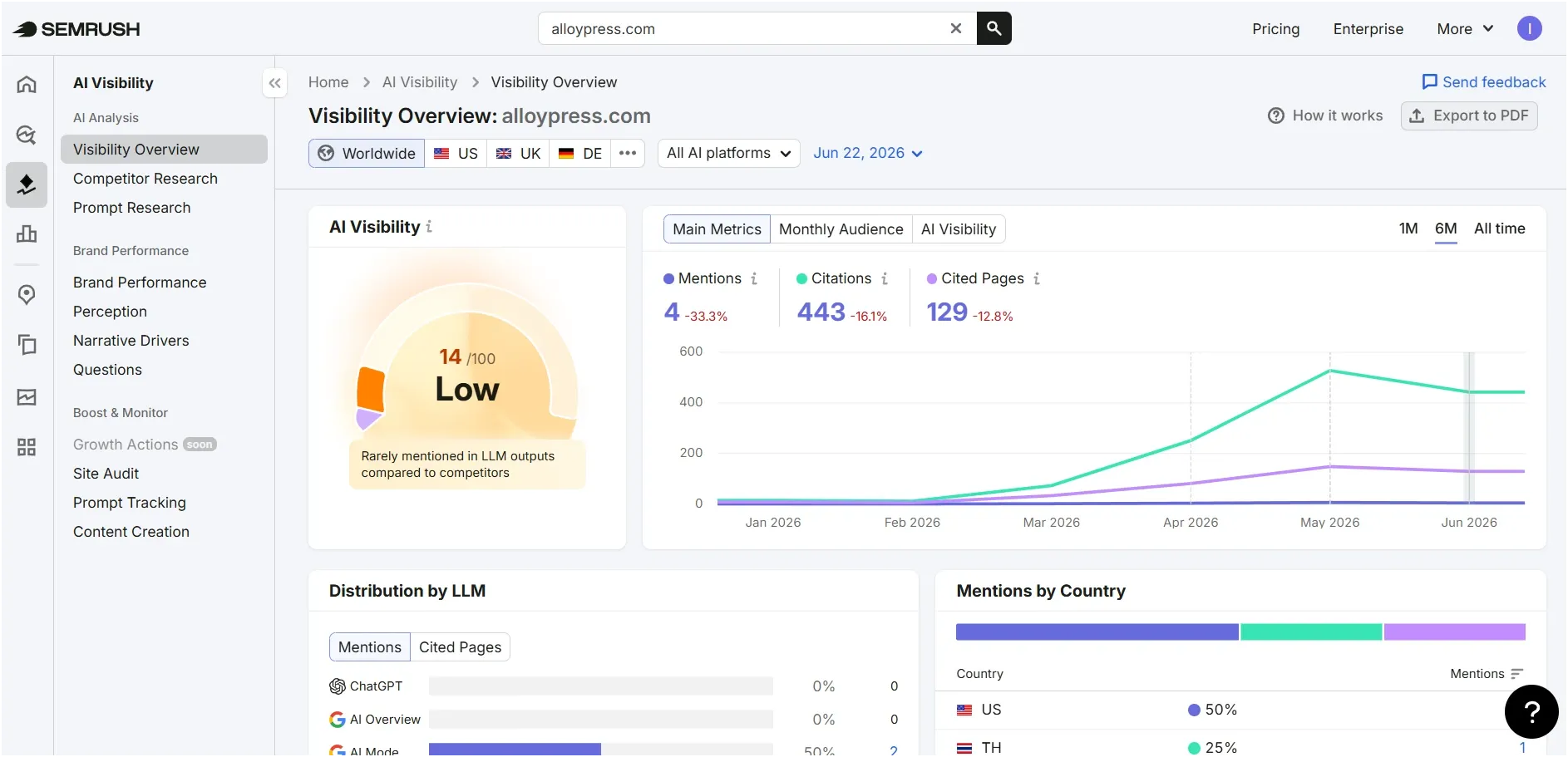
That said, Semrush can feel overwhelming for beginners. There is a lot of data and smaller websites may not use every feature available. But for agencies, SaaS companies and content teams, it’s one of the most complete AI visibility tools currently available.
How It Works
Getting started is straightforward. After adding your domain, you can access the AI Visibility dashboard and review your overall visibility score. From there, you can explore brand mentions, citations, and topic opportunities to understand where your content is performing well and where improvements are needed. These insights can then be used to create new content or optimize existing pages for better AI visibility.
What I Liked
The feature I found most useful was the level of detail provided in the reports. The visualizations make complex data easier to understand, while the topic discovery features help uncover content opportunities that might otherwise be missed. For larger websites and content teams, having all of this information in one place can save a significant amount of research time.
Things to Consider
While Semrush provides powerful insights, it may not be the best fit for everyone. The platform can feel overwhelming for beginners because of the amount of data available, and smaller teams may find the pricing difficult to justify. If you’re only looking for basic AI visibility tracking, some of the advanced features may be more than you need.
Pricing
Semrush AI Visibility is available as part of Semrush’s subscription plans, with pricing depending on the plan you choose.
My Experience
Semrush gives the most complete picture of AI visibility among the three tools I tested.
What impressed me most was the Topics & Sources section. Instead of simply telling me whether a brand appeared in AI answers, it showed where visibility opportunities existed and which topics deserved attention.
For larger content teams, this can save significant research time.
Best for: Agencies, SaaS companies and brands publishing content at scale.
2. SE Ranking AI Search Tools
SE Ranking is one of the few SEO platforms that has built dedicated tools for tracking AI search visibility. As more people use ChatGPT, Gemini, Claude and Google AI Overviews to find information, understanding how your brand appears in these platforms is becoming just as important as tracking traditional search rankings.
What makes SE Ranking interesting is that it doesn’t focus on a single metric. Instead, it combines AI Visibility Tracking, Competitor Analysis, and Source Analysis into one platform. This gives a broader view of how AI systems see your content, which competitors are being mentioned for your target topics, and which websites AI platforms rely on when generating answers.
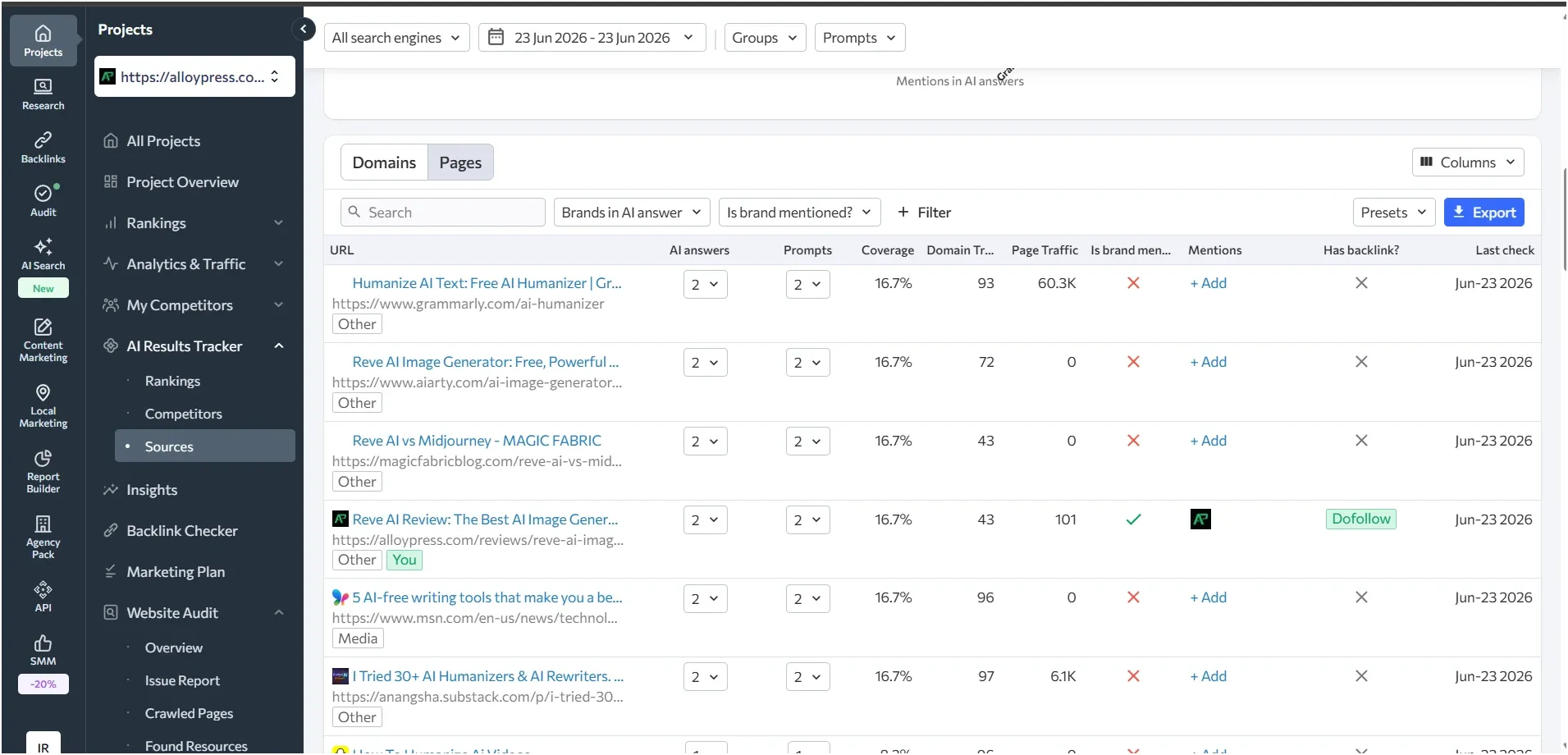
For marketers, agencies, and content teams, these insights can be useful when planning content strategies, identifying visibility gaps and understanding where new opportunities exist to improve presence in AI-powered search experiences.
How It Works
After setting up your project, you can add the keywords, topics, or prompts you want to track. SE Ranking then monitors how your brand appears in AI-generated answers, highlights competitor mentions, and shows which sources are being cited by AI platforms. By reviewing these insights regularly, you can identify content opportunities, improve existing pages, and create a stronger GEO (Generative Engine Optimization) strategy.
What I Liked
What stood out to me most was the Competitor Analysis and Sources reports. Instead of simply showing visibility scores, SE Ranking reveals which websites AI systems trust and which competitors are gaining visibility for specific topics. This makes it easier to understand why certain brands appear in AI-generated answers and what you can do to improve your own visibility. The reports are also straightforward and easy to understand, making the platform accessible even for users who are new to AI SEO.
Things to Consider
While SE Ranking provides valuable insights, its AI visibility database is not as extensive as some larger enterprise platforms. Since AI search tracking is still evolving, some features may continue to improve over time. If you need the deepest level of AI visibility data available, you may find larger platforms offer more comprehensive datasets.
Pricing
SE Ranking plans start at $103.20 per month when billed annually.
My Experience
SE Ranking stood out because of its AI Competitor and Sources reports.
Instead of only showing visibility scores, it helped identify exactly which websites AI systems trust and cite. That information can be extremely valuable when planning content or link-building campaigns.
For agencies and SEO professionals, this was one of the most actionable tools I tested.
Best for: SEO agencies, consultants, and content marketers.
3. SiteGuru AI Visibility Report
SiteGuru approaches AI SEO from a different angle. Rather than focusing heavily on AI mentions, citations, and competitor analysis, it focuses on the actual traffic your website receives from AI platforms. This makes it easier to understand whether tools like ChatGPT, Claude, Gemini and Perplexity are sending visitors to your website and which pages are benefiting the most.
As AI assistants become a larger source of website traffic, many site owners want to know whether their content is being recommended and clicked by users. SiteGuru helps answer that question by showing AI referral traffic alongside traditional organic traffic data.
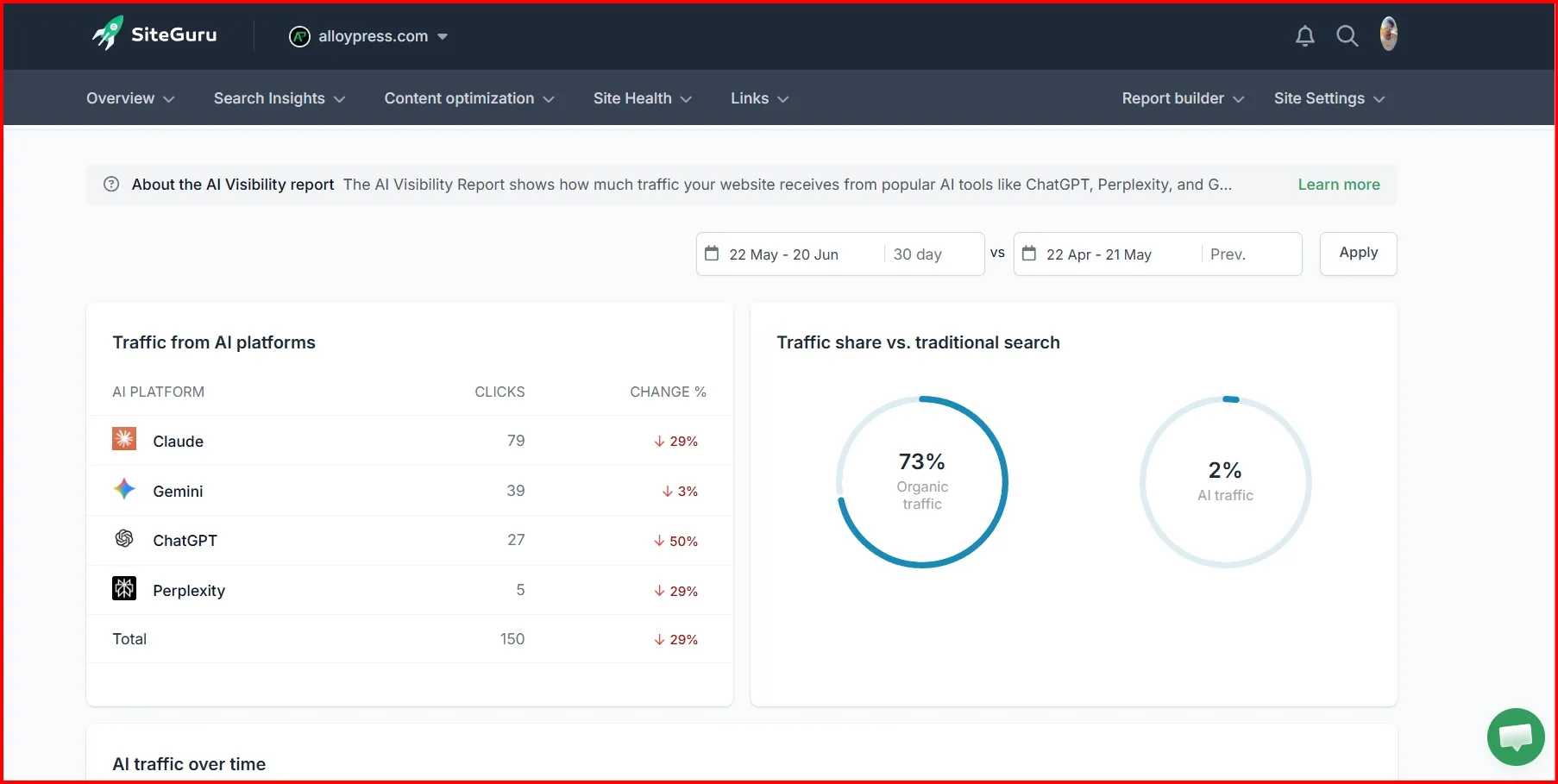
The platform is designed to be simple and easy to understand, making it a good option for bloggers, small businesses, and website owners who want practical insights without spending time analyzing complex visibility reports. Instead of focusing on where your brand is mentioned, SiteGuru focuses on the outcome that matters most to many website owners actual visits and engagement from AI-driven sources.
How It Works
Once connected, SiteGuru tracks visits coming from different AI platforms and displays them in an easy-to-understand dashboard. You can see which AI tools are sending traffic, which pages are receiving the most AI referrals and how AI traffic compares with your traditional organic search traffic. These insights can help you identify the content that AI platforms are recommending most often and create more content around similar topics.
What I Liked
What stood out to me was how simple and practical the tool felt. Unlike some platforms that focus on complex visibility metrics, SiteGuru shows real traffic data that website owners can immediately understand. I also liked being able to see which AI platforms were sending visitors and which pages were benefiting the most. For bloggers and small businesses, this information can be more useful than detailed citation or competitor reports.
Things to Consider
SiteGuru is not as advanced as Semrush or SE Ranking when it comes to competitor analysis and AI source tracking. If your goal is to understand which websites AI systems cite or how competitors are performing in AI search, you’ll need a more comprehensive platform. However, if you mainly want to measure AI-generated traffic and understand its impact on your website, SiteGuru does that very well.
Pricing
SiteGuru plans start at $49 per month, making it the most affordable option among the tools covered in this comparison.
My Experience
SiteGuru takes a different approach.
Instead of focusing heavily on AI mentions and citations, it focuses on actual visits. This makes it useful for website owners who care more about traffic than visibility metrics.
If your goal is understanding whether AI platforms are sending visitors to your site, SiteGuru is the simplest option.
Best for: Bloggers, small businesses and website owners.
Pricing Comparison (June 2026)
Tool | Starting Price* | Best For | AI Visibility Features |
|---|---|---|---|
SiteGuru | $49/month | Bloggers, small businesses, niche sites | AI traffic tracking, AI referral insights, top AI pages |
SE Ranking | $103.20/month (annual billing) | SEO professionals, agencies, content marketers | AI Visibility Tracker, AI Competitor Analysis, AI Sources Report |
Semrush | $117.33/month (annual billing) | Agencies, SaaS companies, enterprise teams | AI Visibility Overview, AI mentions, citations, topic opportunities |
Which AI SEO Tool Should You Choose?
Choose Semrush if you want the deepest AI visibility data.
Choose SE Ranking if competitor analysis and AI source tracking matter most.
Choose SiteGuru if your main goal is monitoring AI traffic and referrals.
My Thoughts After Testing These AI SEO Tools
After testing these AI SEO tools, I feel the industry is still in its early stages. The tools available today provide useful insights into AI visibility, mentions, citations and traffic, but they haven’t reached a point where AI can fully handle SEO from start to finish.
That’s why this blog focuses on what these tools can realistically do right now rather than what they might do in the future.
That said, SEO is changing quickly. As AI technology improves, I expect these tools to become much smarter and automate more of the research, analysis and optimization work that currently requires manual effort.
When that happens, we’ll revisit this article, retest the tools and update our recommendations based on real-world results.
If you’d like to stay updated on the latest AI SEO tools and changes in AI search, consider subscribing so you don’t miss future updates.
Frequently Asked Questions
1. Are AI SEO tools worth it?
Yes, especially if AI-generated search traffic is becoming important for your business. They provide visibility that traditional SEO tools cannot.
2. Can AI SEO tools improve rankings?
Not directly. They provide insights that help you create better content and improve visibility across search engines and AI platforms.
3. Which AI SEO tool is best for beginners?
SiteGuru is the easiest tool to understand and use.
4. Which AI SEO tool is best for agencies?
SE Ranking and Semrush offer stronger reporting and competitor analysis features.
5. Do I still need traditional SEO tools?
Absolutely. AI SEO tools complement traditional SEO tools rather than replace them.
Final Thoughts
AI search is changing how people discover websites.
While Google rankings still matter, brands now need to understand how they appear in AI-generated answers, citations and recommendations.
After testing these tools, I found that each serves a different purpose. Semrush provides the most comprehensive AI visibility data, SE Ranking offers excellent competitor and source analysis, and SiteGuru makes it easy to track AI-driven traffic.
The right choice depends on whether you care most about visibility, competitor intelligence, or actual AI traffic.